
Clinton County Arrest Records
Clinton County arrest records can point to the arrest event, the arresting or processing agency, booking or custody status, and the court identifiers that follow the case. The court charge record begins when a criminal complaint or later charging document is filed and docketed. Clinton County research shows that Infocon includes scanned documents relating to a case or arrest, while UJS Case Search provides the public docket path for charge, event, and disposition data.
The custody side is different. Jail status for Clinton County routes through the Correctional Facility, Pennsylvania VINE, and phone fallback channels. Court charges after arrest route through Magisterial District Court events, the Clerk of Courts, UJS docket sheets, and Common Pleas prosecution. For current custody and booking context, use the Clinton County inmate records page. For the final case file, plea, disposition, and sentence, use Clinton County criminal court records.
Charges After Arrest in Clinton County
In Clinton County, the arrest-to-charges path can begin before a Magisterial District Judge. MDJs conduct preliminary arraignments, set bail, and preside over preliminary hearings. They also issue arrest warrants and search warrants. If charges move forward, the case can continue into the Clinton County Court of Common Pleas, where the District Attorney prosecutes misdemeanor and felony cases and the Clerk of Courts maintains the court file.
The Clinton County District Attorney is the chief law enforcement officer for the county and prosecutes misdemeanor and felony cases before the Court of Common Pleas. Dave Strouse is identified in county sources as District Attorney, serving since 2016. The DA works with local and state police, Adult and Juvenile Probation, the Correctional Facility, and other agencies, but the court file itself remains with the court record system and the Clerk of Courts.
| Document or event | Where it fits | What to check |
|---|---|---|
| Criminal complaint | Often the first court charging document after arrest. | Complaint number, incident number, charges, OTN, and MDJ office. |
| Preliminary arraignment | Early MDJ proceeding after arrest or warrant service. | Bail, next hearing, and custody or release conditions. |
| Preliminary hearing | MDJ event testing whether charges proceed. | Held, waived, dismissed, or moved toward Common Pleas. |
| Criminal information | Common Pleas charging document when the prosecution proceeds. | Final filed counts, grading, amendments, and prosecutor action. |
| Indictment | Not the normal local path described in Clinton County research. | Use only if the docket or prosecutor record shows one. |
Find Clinton Arrest Records and Charges
The best public starting point for the charge side is UJS Case Search. Search by Participant Name, Docket Number, OTN, Complaint Number, Incident Number, or Calendar Event. For Clinton County, set County to Clinton or Judicial District to Clinton - 25 where available. If the case is at the MDJ stage, the office list can include MDJ-25-3-01, MDJ-25-3-02, MDJ-25-3-03, or Clinton Central Court.
- Search UJS by name, docket number, OTN, complaint number, or incident number.
- Filter to Clinton County or the 25th Judicial District when the form gives that option.
- Open the docket and review each listed charge, not just the case title.
- Compare the charge list with event entries, bail, preliminary hearing notes, and disposition fields.
- Use Infocon or the Clerk of Courts if a scanned complaint, arrest-related filing, or certified copy is needed.
Clinton County's Online Public Records Access page says Infocon provides fee-based access to Clerk of Court docket information, scanned documents relating to a case or arrest, and judgments. That local scanned-document channel is important because UJS often gives a public docket sheet rather than every underlying filing.
Clinton Charge Status Terms
Charge status can change more than once. A single arrest may lead to several counts, and each count can take a different path. Some charges are held for court. Some are withdrawn or dismissed. Some are reduced or amended. The docket must be read count by count because one offense can end in a conviction while another count from the same arrest is dismissed.
| Status | What it means in the charge record |
|---|---|
| Pending | The charge has not reached final disposition in the public docket. |
| Held for court | The MDJ stage sent the charge forward toward Common Pleas. |
| Amended or reduced | The filed charge changed, often by count, grade, or statute reference. |
| Dismissed | The court did not continue that charge as filed. |
| Withdrawn | The prosecution or filing side withdrew the charge from the case path. |
| Nolle prosequi | The prosecutor declined to proceed on a charge, when shown by the court record. |
| Guilty or not guilty | The count reached a plea or verdict result that must be read with sentence entries. |
Note: A charge status is not the same as current custody; custody status is checked through jail, VINE, or court release information.
What Arrest Charge Records Show
UJS and county records can show several identifiers that connect an arrest to the court charge record. These fields help avoid mismatching people with similar names. They also help the Clerk of Courts locate the right scanned document or certified copy request. If the charge started in an MDJ office, the MDJ docket details may be just as important as the Common Pleas case number.
| Field | Why it matters |
|---|---|
| OTN | The Offense Tracking Number links Pennsylvania criminal case activity. |
| Complaint number | Connects the charge to the complaint filed after the arrest or incident. |
| Incident number | Connects court data to the law-enforcement incident reference. |
| MDJ office | Shows which Magisterial District Court handled early proceedings. |
| Charge and statute | Identifies the offense and legal citation listed in the docket. |
| Disposition | Shows the result for that count, not just the initial accusation. |
| Bail and hearing events | Show arraignment, release conditions, preliminary hearing, and later court dates. |
Charges and Convictions
Arrest records and court charges do not prove a conviction. A charge is an allegation filed in the court system. A conviction is a final result after a guilty plea or verdict. Pennsylvania UJS warns that public docket information is not a substitute for a Pennsylvania State Police criminal history background check, and that warning is especially important for arrest and charge searches.
| Question | Charge | Conviction |
|---|---|---|
| What is it? | A filed accusation after arrest or complaint. | A final guilt result by plea or verdict. |
| Can it change? | Yes, it may be amended, reduced, withdrawn, or dismissed. | It can be appealed or later affected by court order, but it is final at disposition. |
| Where to read it? | Charge list, complaint, criminal information, and event entries. | Disposition, plea, verdict, sentence, and cost entries. |
| Risk of error? | High if read without status. | High if read without sentence, appeal, or later order entries. |
Statewide Charge Lookup Limits
Pennsylvania has more than one statewide record path. UJS is the judiciary's free public docket system. Pennsylvania VINE gives custody status and criminal case notification options. Pennsylvania State Police criminal history checks are separate from UJS docket sheets. The Pennsylvania Megan's Law public website is a public notice system for registered sex offender information and is based on separate publication authority.
The Pennsylvania Megan's Law site was captured as the successful source image for Clinton County arrest and charge records research.
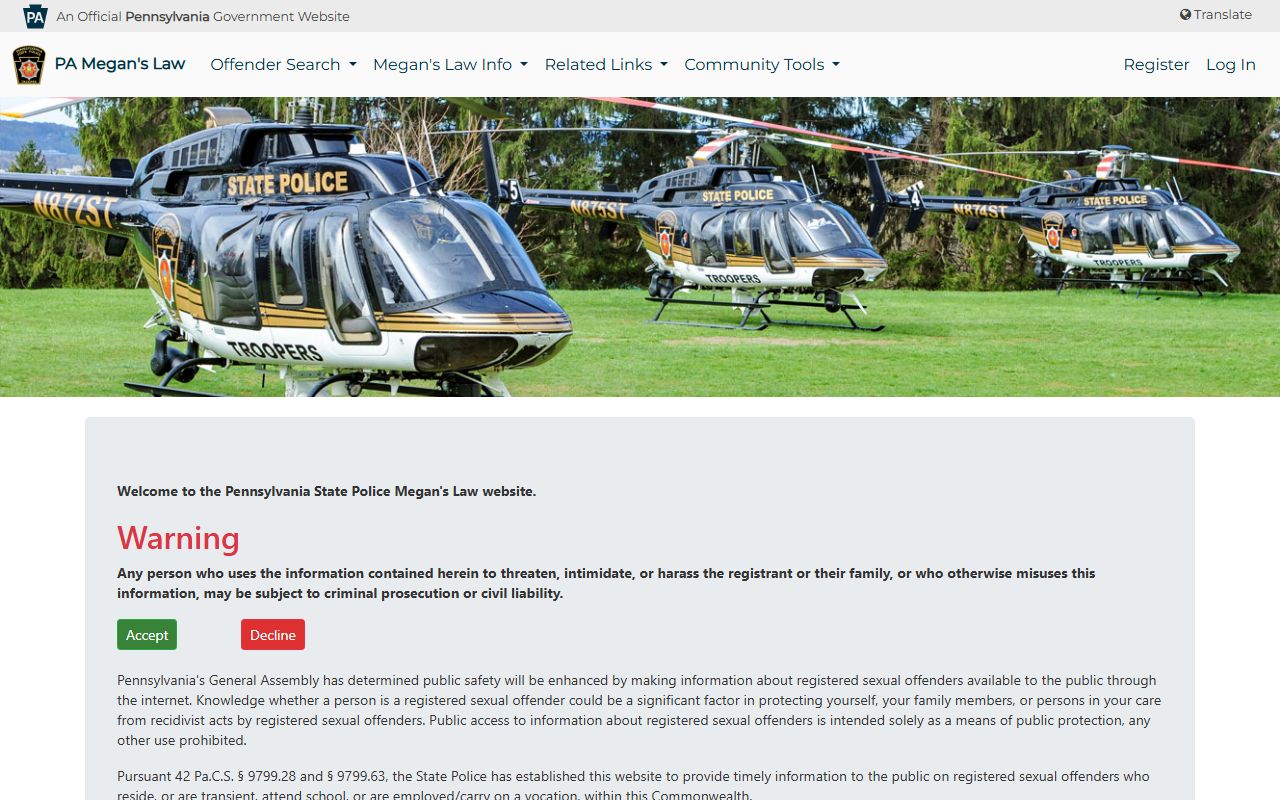
Megan's Law information should not be treated as a full arrest record or complete charge history. It serves a specific public notice purpose and should be checked only for that kind of registered offender information.
Sealed or Expunged Charges
Some arrest and charge records are not public. UJS and PAePay restrictions indicate that minors, sealed cases, secured cases, and limited-access matters may not appear in public search or payment results. Clinton County Orphans' Court adoption records are sealed, and juvenile criminal matters have special access limits. Public access policies also restrict confidential identifiers.
| Point | Sealed or limited access | Expunged |
|---|---|---|
| Public result | The case or charge may be hidden from UJS or PAePay. | The covered arrest or court record is removed as ordered. |
| How it happens | By law, policy, or court order. | Through a court petition and order under Pa.R.Crim.P. 790. |
| What to verify | Whether the missing result is restricted rather than nonexistent. | Exact docket, OTN, charge, and order scope. |
Expungement eligibility should not be guessed from a docket caption. Pennsylvania expungement and limited access depend on disposition, offense type, waiting period, ARD or summary status, pardon, age, and other case facts.
Clinton Arrest Charge Contacts
Use the office that matches the record. The Clerk of Courts is the local contact for Common Pleas criminal files and certified copies. The Sheriff's Office can help with warrant questions and civil or criminal warrant verification. The Correctional Facility and VINE serve custody status. The DA prosecutes criminal cases but does not replace the court as the public copy source.
Prothonotary and Clerk of Courts
230 East Water Street
Lock Haven, PA 17745
Phone: 570-893-4007
Email: Prothonotary@ClintonCountyPA.Gov
Hours: Monday, Tuesday, Thursday, Friday 8:00 a.m. to 5:00 p.m.; Wednesday 8:00 a.m. to 12:30 p.m.
For recent cases, news, and announcements, the District Attorney page directs users to the Clinton County District Attorney CrimeWatch App. No sheriff-specific mobile app was located in the reviewed official sources, so app-based arrest or warrant access should not be assumed.